

We build homes. Not snack bars.
Step into a hidden world of new beginnings.
Your backstage pass to the wild. A smart birdhouse designed to protect nature, built for you to witness it live.
coming soon to

Get Priority Access to Super Early Bird Pricing!
Rewards are limited. Join the waitlist to get notified first and secure the best deal before it’s gone.
Success! Check Your Inbox to Join the Flock.
One Small Step Left!
We just sent a crucial confirmation email to the address you provided. Please click the link inside that email to verify your address and officially secure your spot. Your privacy is our priority, and this confirms you want to join.
Most of nature's magic happens where we can't see it.
Every spring, new life begins in silence – twigs become nests, eggs hatch, and tiny wings learn to fly.
Until now, these moments have been hidden inside wooden walls.
With Tiny Friends, you can experience these incredible stories up close – watch, learn, and reconnect with the beauty of nature.
The First Twig – Building the Home.
See how devoted parent birds work tirelessly to build the perfect nest — each twig chosen with care.
Hatching Day – The Quiet Miracle.
Be there for the moment of life — get instant notifications when eggs hatch, and witness the first feeding moments – a moment you can save, share, and cherish forever.
Growing Up – The Journey to First Flight.
Watch them grow day by day and see the devoted mother return again and again with food and warmth, until those tiny wings are finally ready to fly.
Every moment. Right in your hands.
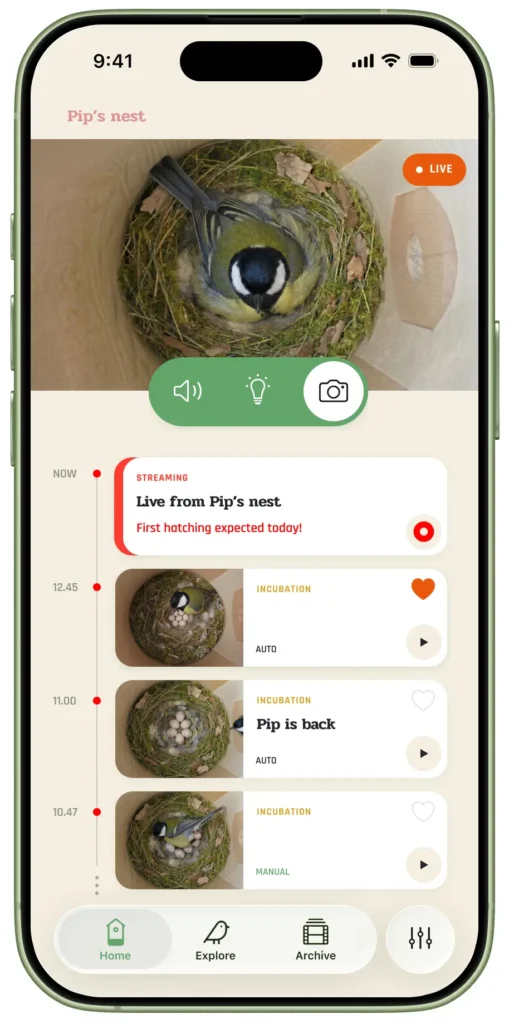
The app watches when you can’t. It knows when something worth seeing is happening, and it tells you.
The morning the first visitor peers through the entrance. The first twig carried in. Eggs. Hatching. And sometimes, just weeks later, a whole new family starting over.

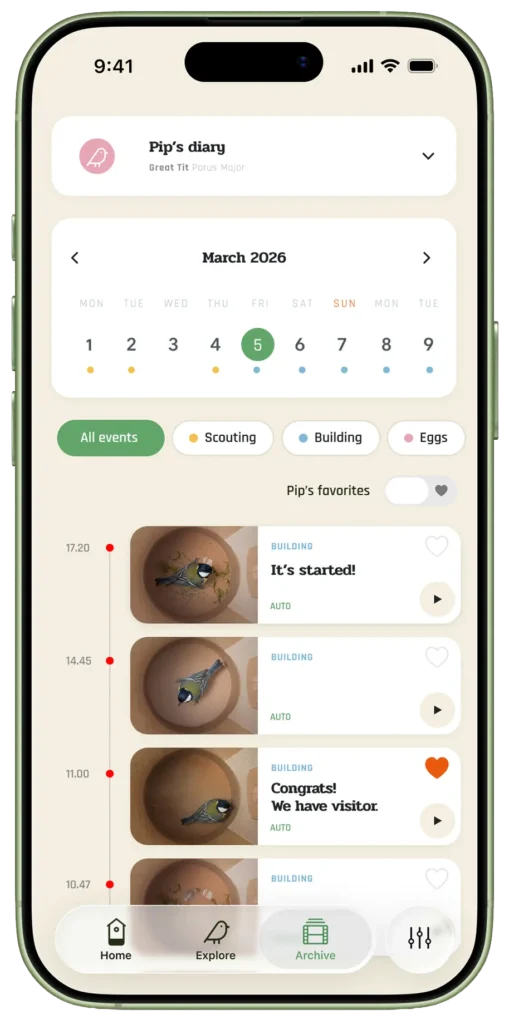
Each milestone is detected automatically and saved with a clip, so nothing slips by, even when you’re not watching.
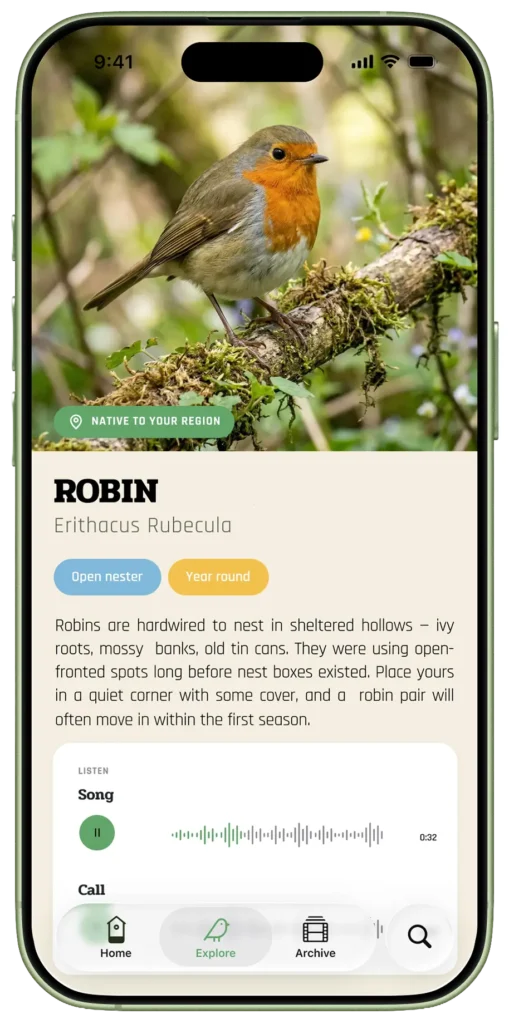
Live stream, a diary of every milestone, and a built-in guide to whoever just moved in. Every visit logged. Every hatch saved. Every species identified — with its song, its habits, and a little of its history. Learn their name, understand what you’re watching, and follow the whole story without leaving your sofa. Miss nothing. Go nowhere.
Get Priority Access to Super Early Bird Pricing!
Rewards are limited. Join the waitlist to get notified first and secure the best deal before it’s gone.
Success! Check Your Inbox to Join the Flock.
One Small Step Left!
We just sent a crucial confirmation email to the address you provided. Please click the link inside that email to verify your address and officially secure your spot. Your privacy is our priority, and this confirms you want to join.
Nature doesn't do right angles. Neither do we.
A bird’s natural nest site is a hollow in a tree, a mossy crevice, a curved bank of earth. Nothing in nature has corners. The TinyFriends birdhouse was designed with that in mind — soft forms, organic curves, and materials that weather into the garden rather than standing apart from it. A home that looks like it belongs outside is one a bird is more likely to trust.


Two nests. One story.
Birds nest differently. Choose the Classic Nest for cavity nesters like Tits and Bluebirds, or the Open Nest for other species like Robins and Phoebes. Both stream every magical moment to your phone.
Not sure which birds visit your garden? A species guide for both nests is waiting below.
Inspired by nature. Designed with ornithologists.

2-Second Twist-Clean
Hygiene is vital. The entire nesting base twists off in seconds – no tools required. Dump the old nest, rinse, and twist it back on for the next season.

Wood Interior
Because the inside of a home should feel like the inside of a tree. Natural, untreated wood on every interior surface — breathable, grippy, and warm. The surface birds have trusted since long before we started building houses for them.

Active Airflow Channels
Our double-wall design features integrated ventilation channels. This creates an insulating air gap that prevents overheating in summer and retains warmth in spring.

Interchangeable Entrances
Invite the birds you love. Easily swap the entrance plate to attract specific species – from Blue Tits to Starlings – while keeping larger predators out.

Solar Powered & Wireless
Designed to be set and forgotten. Position the solar panel where the sun hits best, and TinyFriends runs autonomously all season long. No check-ins, no reason to ever disturb the nest.

Crystal Clear HD & Night Vision
Watch every detail in 1080p HD. Invisible infrared LEDs provide a clear view 24/7 without disturbing the sleeping birds with bright lights.
Up in five minutes.
One screwdriver, five minutes. Hang it up – then nature does the rest.


Mount the bracket. Slide it on. That’s it. The included metal bracket goes on any flat surface. TinyFriends clicks into place — snug, secure, and ready for its first resident.
Trees have their own rules. The optional adapter handles surfaces that aren’t at a perfect 90° — with precise angle adjustment built in. Because nature is rarely flat.
Get Priority Access to Super Early Bird Pricing!
Rewards are limited. Join the waitlist to get notified first and secure the best deal before it’s gone.
Success! Check Your Inbox to Join the Flock.
One Small Step Left!
We just sent a crucial confirmation email to the address you provided. Please click the link inside that email to verify your address and officially secure your spot. Your privacy is our priority, and this confirms you want to join.
One Garden. Two Worlds.
Different birds, different needs. That’s why TinyFriends comes in two versions — so every garden visitor has a place to call home.
Most garden birds — like Tits, Chickadees, and Nuthatches — prefer enclosed nests where they feel safe and hidden. But some of nature’s most beloved species won’t touch them. Robins, Wrens, Flycatchers, and Redstarts only nest in open-fronted designs, where they can see their surroundings.


Birds that exclusively use the Classic Nest as their sanctuary
Birds that exclusively use the Open Nest as their sanctuary

Great Tit
Parus major
Europe’s most reliable nest box tenant — and one of its most watchable parents.
The Great Tit is the bird that made nest boxes famous. Bold, intelligent, and endlessly curious, it scouts potential nesting sites weeks before the season begins — often peering into the entrance hole with the focused assessment of someone reading a lease. Once it moves in, it builds a deep moss-and-hair cup and raises 8 to 12 chicks in a single brood. Few birds make the camera earn its keep quite like a Great Tit family at full capacity.

Eurasian Nuthatch
Sitta europaea
The only European bird that walks headfirst down trees — and plasters its front door shut.
The Nuthatch has one habit that sets it apart from every other nest box user: if the entrance hole is too large, it will reduce it to the exact size it wants using beakfuls of mud, plastered on with architectural precision. It is a bird that engineers its own home. Inside, it lines the box with bark flakes and leaves, and defends its territory year-round with a loud, carrying call that sounds nothing like a bird its size. Once a pair adopts a box, they rarely leave it.

Blue Tit
Cyanistes caeruleus
Small enough to fit in your palm. Ambitious enough to raise a dozen chicks at once.
The Blue Tit’s cobalt cap and sulphur-yellow breast make it one of the most immediately recognizable birds in Europe — and one of the most enthusiastic nest box users on the continent. It lines its nest with extraordinary care: moss, wool, spider silk, and feathers, built up over days into a soft, insulated cup. Clutches of 10 to 14 eggs are not unusual. Watching a Blue Tit pair make that many trips to feed that many chicks is genuinely exhausting to observe, and completely impossible to stop watching.

Common Starling
Sturnus vulgaris
The most theatrical nest box tenant in Europe, and the one that moves in without asking.
The Common Starling is glossy, noisy, and entirely convinced that any cavity it finds belongs to it by right. In spring, the male sings from the entrance hole with remarkable persistence — a cascading mix of whistles, clicks, and surprisingly accurate impressions of other birds. Once a pair claims a box, they line it with fresh green plants, a deliberate habit that suppresses parasites in the nest. Clutches of four to six pale blue eggs are typical, and starlings often raise two broods in a season. The same bird that woke your neighbours at dawn is also part of the murmurations — tens of thousands of birds moving as a single shape across the sky.

Robin
Erithacus rubecula
Europe’s most beloved garden bird — and a passionate open-nest devotee.
Robins are hardwired to nest in sheltered hollows, ivy roots, mossy banks and old tin cans. They were using open-fronted spots long before nest boxes existed. Unlike most garden birds, robins are remarkably tolerant of human activity near the nest. A pair will often set up home within arm’s reach of a busy door or garden tap, and carry on regardless. Place your open-fronted box in a quiet corner with some cover, position it low and half-hidden, and a robin pair will often move in within the first season. Once settled, they are devoted parents. The female incubates alone while the male brings food, and both work tirelessly once the chicks hatch.

Spotted Flycatcher
Muscicapa striata
A summer visitor that almost never uses enclosed boxes.
The Spotted Flycatcher is a late-arriving summer migrant and one of the most aerial hunters in the garden. It perches motionless on an exposed branch or post, then launches in acrobatic bursts to catch insects mid-flight, often returning to the exact same perch after every strike. Almost exclusively an open nester. Ledges, climbing plants, and open-fronted boxes are the only options it will accept. Despite its understated brown plumage, it is one of the most watchable birds in the garden once you know its habits. Each pair typically raises two broods before the long flight back to sub-Saharan Africa in late summer.

Wren
Troglodytes troglodytes
Tiny in size. Enormous in personality.
Don’t let the size fool you. The wren’s explosive song carries further than most birds twice its weight, and its personality matches. In the wild they tuck nests into mossy crevices, low tangled roots, and ivy-covered banks. An open-fronted box mounted low and half-hidden by climbing plants is exactly what they are looking for. The male wren builds multiple rough nest structures within his territory, sometimes four or five, and then invites a female to choose and line the one she prefers with feathers and fine moss. It is an arrangement that has apparently worked for a very long time.

Pied Wagtail
Motacilla alba
Elegant, bold, and surprisingly easy to attract.
Pied Wagtails are classic opportunists. They’ve nested in flowerpots, letterboxes, engine bays, and open-fronted shelves of every description. In nature they favour open ledges near water or buildings, and an open-fronted box in a busy garden spot doesn’t deter them at all. If anything, they seem to prefer the company. The male’s crisp black-and-white plumage and constantly bobbing tail make it one of the most instantly recognisable birds at any garden nest site. They are year-round residents across most of the UK and Europe, often raising two or even three broods in a season when conditions allow.

Black-capped Chickadee
Poecile atricapillus
America’s most fearless little bird — the one that eats from your hand.
The Black-capped Chickadee is the bird that North Americans grow up with. It is bold enough to land on an outstretched hand, sharp enough to remember the exact location of thousands of cached seeds through winter, and sociable enough to approach humans with what can only be described as genuine curiosity. It excavates its own nest cavity in soft rotting wood, but readily accepts a nest box as an upgrade. The contrast of its crisp black cap and bib against snow-white cheeks makes it one of the most photogenic birds on the continent, in any season.

House Wren
Troglodytes aedon
The smallest bird in North America that will absolutely tell you what it thinks of you.
TThe House Wren is a study in contradictions. It weighs less than a AA battery, yet its song is one of the loudest and most relentless in the garden. It is one of the most widespread birds on the continent, found from Canada to the southern tip of South America, yet it will establish a fiercely defended territory around a single nest box and drive off birds three times its size. It builds its nest from sticks, filling the box almost completely before adding a soft inner cup of grass, feathers, and spider silk. The male often builds several dummy nests in neighbouring cavities to discourage competition. A box with a 32mm entrance hole in a sheltered spot near shrubby cover is exactly what it is looking for, and once it finds one, it tends to come back year after year.

Eastern & Western Bluebird
Sialia sialis · Sialia mexicana
Two species, one story — the garden bird that came back because of nest boxes.
The Eastern and Western Bluebird are close cousins that together cover virtually the entire continental United States — the Eastern across the Midwest and south, the Western along the Pacific coast and mountain foothills. Both share the same vivid cobalt-blue plumage, the same warm russet breast, and the same remarkable conservation story: by the mid-20th century both had largely vanished from suburban America, outcompeted for natural cavities by introduced species. Nest box programs brought them back. Today a pair of bluebirds claiming a box and raising two broods through summer is one of the most celebrated sights in North American garden birdwatching.

White-breasted Nuthatch
Sitta carolinensis
The American answer to the Eurasian Nuthatch — just as acrobatic, just as opinionated.
Like its European cousin, the White-breasted Nuthatch spends most of its life moving down tree trunks headfirst, probing bark for insects that other birds miss entirely. It is a year-round resident across most of North America, territorial and vocal, with a nasal call that carries surprisingly far through winter woodland. It takes to nest boxes readily, preferring sites near mature trees — and once it claims a box, neighbouring birds tend to give it a respectful distance.

Eastern Phoebe
Sayornis phoebe
One of the first birds to return every spring — and one of the most loyal nesters.
The Eastern Phoebe was the first North American bird ever banded for research — and the first to prove it returns to the exact same nest site year after year. It naturally plasters mud-and-moss nests onto ledges, bridges, and eaves. An open-fronted box is the closest thing to a perfect phoebe home you can offer.
The phoebe is a flycatcher — it perches in the open, sallies out to catch insects in mid-air, and returns reliably to the same spot. Its soft, raspy fee-bee call is one of the first sounds of spring across eastern North America. Mount a box under an eave or on a sheltered post, and a phoebe pair may raise two full broods there before summer is over.

Carolina Wren
Thryothorus ludovicianus
North America’s most adaptable open nester — will nest almost anywhere sheltered.
Carolina Wrens have been found nesting in old boots, hanging flower baskets, and even car engines left parked too long. Unlike most birds, they don’t migrate — making them year-round residents and reliably early nesters. An open-fronted box suits them perfectly: sheltered enough to feel safe, open enough to match their boldness.
Despite weighing less than a 20-gram coin, the Carolina Wren produces one of the loudest songs of any North American bird — a ringing teakettle-teakettle-teakettle that carries far through dense cover. Mated pairs stay together year-round, moving through their territory as a unit and duetting constantly. Place a nest box low in sheltered shrubby cover and a pair may use it not only for nesting but as a winter roost on cold nights.

Black Redstart
Phoenicurus ochruros
The bird that turned urban Europe into its nesting ground.
Once a species of rocky mountain slopes, the Black Redstart discovered buildings — and never looked back. Today it nests on ledges, in wall niches, and in sheltered open recesses exactly like the Open Nest insert. The male is unmistakable: charcoal black with a burnt-orange tail that quivers constantly, even at rest. It arrives early in spring and raises two full broods per season. Almost never uses an enclosed box — give it an open-fronted shelter and it will treat your garden like the cliff face it always knew.

House Finch
Haemorhous mexicanus
The most widespread garden bird in North America — and a devoted open nester.
The House Finch builds open cup nests in almost any sheltered spot it can find — hanging baskets, ledges, vine tangles, porch overhangs. It never uses enclosed nest boxes. What it looks for is exactly what the Open Nest insert offers: a protected platform with good visibility and easy access. The male’s raspberry-red head and breast make it one of the most immediately recognizable birds at any garden nest box, and a pair will often raise two or three broods in a single season.
Originally native to the western United States, the House Finch was introduced to the east in the 1940s and has since spread across the entire continent. The male’s rich, warbling song is one of the most cheerful sounds in any suburban garden from early spring right through summer. Females choose their mate partly on the intensity of his red colouring — a signal of good health and foraging ability.
The team.
TinyFriends began as a curiosity between four people who couldn’t stop wondering what was happening inside the nest boxes in their own gardens. It grew, slowly and stubbornly, through prototype after prototype — guided less by what we thought would work, and more by what the birds were willing to live in.
Two years later, we’re still listening.
Frequently asked questions
Do I need a monthly subscription to use the app?
No. We believe you shouldn’t pay rent for your own birdhouse. Tiny Friends comes with lifetime app access for live streaming and notifications. Optional cloud storage plans will be available for saving history, but the core experience is free forever.
How does the power system work?
It’s completely wireless. The integrated solar roof charges the built-in battery during the day. Even on cloudy days, the high-capacity battery ensures the camera runs smoothly. You don’t need to run cables or change batteries during nesting season.
Is it difficult to install?
Not at all. It takes about 5 minutes. We include a universal mount that straps easily to a tree trunk or screws into a wall/fence. No electrician required.
Will it work with my Wi-Fi?
Yes, Tiny Friends connects to standard 2.4GHz home Wi-Fi networks. The external antenna ensures a strong signal even in the garden.
Is it really safe for birds?
Yes, safety is our #1 priority. We use invisible infrared light (no bright LEDs that disturb sleep), active ventilation to prevent overheating, and a predator-proof design. It’s designed by engineers, but approved by ornithologists.
Get Priority Access to Super Early Bird Pricing!
Rewards are limited. Join the waitlist to get notified first and secure the best deal before it’s gone.
Success! Check Your Inbox to Join the Flock.
One Small Step Left!
We just sent a crucial confirmation email to the address you provided. Please click the link inside that email to verify your address and officially secure your spot. Your privacy is our priority, and this confirms you want to join.
We build homes. Not snack bars.
Step into a hidden world of new beginnings.
A smart birdhouse designed to protect nature, built for you to witness it live.
coming soon to

Get the Super Early Bird Price!
Limited spots available. Sign up to get notified first when we launch.
Success! Check Your Inbox to Join the Flock.
One Small Step Left!
We just sent a crucial confirmation email to the address you provided. Please click the link inside that email to verify your address and officially secure your spot. Your privacy is our priority, and this confirms you want to join.
Most of nature's magic happens where we can't see it
Every spring, new life begins in silence. Twigs become nests. Eggs hatch. Tiny wings learn to fly. Until now, these moments stayed hidden inside wooden walls.
With TinyFriends, you’re finally there.
The First Twig Watch devoted parents build the perfect nest, one twig at a time.
Hatching Day Get notified the moment eggs hatch. A moment worth saving forever.
First Flight See them grow day by day, until those tiny wings are ready.
Every moment. Right in your hands.
The app watches when you can’t. It knows when something worth seeing is happening — and tells you instantly.
The first visitor. The first twig. Eggs. Hatching. Sometimes, just weeks later, a whole new family starting over.
Every milestone is detected automatically and saved as a clip. Nothing slips by.
Live stream. Milestone diary. Species guide. Every visit logged. Every hatch saved. Every species identified — with its song, its habits, a little of its story.
Follow the whole thing without leaving your sofa.
Get the Super Early Bird Price!
Limited spots available. Sign up to get notified first when we launch.
Success! Check Your Inbox to Join the Flock.
One Small Step Left!
We just sent a crucial confirmation email to the address you provided. Please click the link inside that email to verify your address and officially secure your spot. Your privacy is our priority, and this confirms you want to join.
Nature doesn't do right angles. Neither do we.
A bird’s natural nest site is a hollow in a tree, a mossy crevice, a curved bank of earth. Nothing in nature has corners. The TinyFriends birdhouse was designed with that in mind — soft forms, organic curves, and materials that weather into the garden rather than standing apart from it. A home that looks like it belongs outside is one a bird is more likely to trust.
Two nests. One story.
Birds nest differently. Choose the Classic Nest for cavity nesters like Tits and Bluebirds, or the Open Nest for other species like Robins and Phoebes. Both stream every magical moment to your phone.
Not sure which birds visit your garden? Keep scrolling – we’ve got a species guide for both nest types.
Inspired by nature. Designed with ornithologists.
2-Second Twist-Clean
Hygiene is vital. The entire nesting base twists off in seconds – no tools required. Dump the old nest, rinse, and twist it back on for the next season.
Interchangeable Entrances
Invite the birds you love. Easily swap the entrance plate to attract specific species – from Blue Tits to Starlings – while keeping larger predators out.
Wood Interior
Because the inside of a home should feel like the inside of a tree. Natural, untreated wood on every interior surface — breathable, grippy, and warm. The surface birds have trusted since long before we started building houses for them.
Active Airflow Channels
Our double-wall design features integrated ventilation channels. This creates an insulating air gap that prevents overheating in summer and retains warmth in spring.
Crystal Clear HD & Night Vision
Watch every detail in 1080p HD. Invisible infrared LEDs provide a clear view 24/7 without disturbing the sleeping birds with bright lights.
Solar Powered & Wireless
Designed to be set and forgotten. Position the solar panel where the sun hits best, and TinyFriends runs autonomously all season long. No check-ins, no reason to ever disturb the nest.
Get the Super Early Bird Price!
Limited spots available. Sign up to get notified first when we launch.
Success! Check Your Inbox to Join the Flock.
One Small Step Left!
We just sent a crucial confirmation email to the address you provided. Please click the link inside that email to verify your address and officially secure your spot. Your privacy is our priority, and this confirms you want to join.
Up in five minutes.
One screwdriver, five minutes. Hang it up – then nature does the rest.
Mount the bracket. Slide it on. That’s it. The included metal bracket goes on any flat surface. TinyFriends clicks into place — snug, secure, and ready for its first resident.


Trees have their own rules. The optional adapter handles surfaces that aren’t at a perfect 90° — with precise angle adjustment built in. Because nature is rarely flat.
One Garden. Two Worlds.
Different birds, different needs. That’s why TinyFriends comes in two versions — so every garden visitor has a place to call home.
Most garden birds — like Tits, Chickadees, and Nuthatches — prefer enclosed nests where they feel safe and hidden. But some of nature’s most beloved species won’t touch them. Robins, Wrens, Flycatchers, and Redstarts only nest in open-fronted designs, where they can see their surroundings.

Birds that exclusively use the Classic Nest as their sanctuary
Great Tit
Parus major
Europe’s most reliable nest box tenant — and one of its most watchable parents.
The Great Tit is the bird that made nest boxes famous. Bold, intelligent, and endlessly curious, it scouts potential nesting sites weeks before the season begins — often peering into the entrance hole with the focused assessment of someone reading a lease. Once it moves in, it builds a deep moss-and-hair cup and raises 8 to 12 chicks in a single brood. Few birds make the camera earn its keep quite like a Great Tit family at full capacity.
Blue Tit
Cyanistes caeruleus
Small enough to fit in your palm. Ambitious enough to raise a dozen chicks at once.
The Blue Tit’s cobalt cap and sulphur-yellow breast make it one of the most immediately recognizable birds in Europe — and one of the most enthusiastic nest box users on the continent. It lines its nest with extraordinary care: moss, wool, spider silk, and feathers, built up over days into a soft, insulated cup. Clutches of 10 to 14 eggs are not unusual. Watching a Blue Tit pair make that many trips to feed that many chicks is genuinely exhausting to observe, and completely impossible to stop watching.
Eurasian Nuthatch
Sitta europaea
The only European bird that walks headfirst down trees — and plasters its front door shut.
The Nuthatch has one habit that sets it apart from every other nest box user: if the entrance hole is too large, it will reduce it to the exact size it wants using beakfuls of mud, plastered on with architectural precision. It is a bird that engineers its own home. Inside, it lines the box with bark flakes and leaves, and defends its territory year-round with a loud, carrying call that sounds nothing like a bird its size. Once a pair adopts a box, they rarely leave it.
Common Starling
Sturnus vulgaris
The most theatrical nest box tenant in Europe, and the one that moves in without asking.
The Common Starling is glossy, noisy, and entirely convinced that any cavity it finds belongs to it by right. In spring, the male sings from the entrance hole with remarkable persistence — a cascading mix of whistles, clicks, and surprisingly accurate impressions of other birds. Once a pair claims a box, they line it with fresh green plants, a deliberate habit that suppresses parasites in the nest. Clutches of four to six pale blue eggs are typical, and starlings often raise two broods in a season. The same bird that woke your neighbours at dawn is also part of the murmurations — tens of thousands of birds moving as a single shape across the sky.
Black-capped Chickadee
Poecile atricapillus
America’s most fearless little bird — the one that eats from your hand.
The Black-capped Chickadee is bold enough to land on an outstretched hand, sharp enough to remember thousands of cached seeds through winter, and sociable enough to approach humans with genuine curiosity. It excavates its own nest cavity in soft rotting wood, but readily accepts a nest box. Its crisp black cap and bib against snow-white cheeks make it one of the most photogenic birds on the continent.
Eastern & Western Bluebird
Sialia sialis · Sialia mexicana
Two species, one story — the garden bird that came back because of nest boxes.
The Eastern and Western Bluebird together cover virtually the entire continental United States. Both share the same vivid cobalt-blue plumage, the same warm russet breast, and the same remarkable conservation story: by the mid-20th century both had largely vanished from suburban America. Nest box programs brought them back. Today a pair of bluebirds claiming a box and raising two broods through summer is one of the most celebrated sights in North American garden birdwatching.
House Wren
Troglodytes aedon
The smallest bird in North America that will absolutely tell you what it thinks of you.
The House Wren weighs less than a AA battery, yet its song is one of the loudest and most relentless in the garden. It will establish a fiercely defended territory around a single nest box and drive off birds three times its size. A box with a 32mm entrance hole in a sheltered spot near shrubby cover is exactly what it’s looking for — and once it finds one, it tends to come back year after year.
White-breasted Nuthatch
Sitta carolinensis
The American answer to the Eurasian Nuthatch — just as acrobatic, just as opinionated.
Like its European cousin, the White-breasted Nuthatch spends most of its life moving down tree trunks headfirst, probing bark for insects that other birds miss entirely. It is a year-round resident across most of North America, territorial and vocal, with a nasal call that carries surprisingly far through winter woodland. It takes to nest boxes readily, preferring sites near mature trees — and once it claims a box, neighbouring birds tend to give it a respectful distance.

Birds that exclusively use the Open Nest as their sanctuary
Robin
Erithacus rubecula
Europe’s most beloved garden bird — and a passionate open-nest devote.
Robins are hardwired to nest in sheltered hollows — ivy roots, mossy banks, old tin cans. They were using open-fronted spots long before nest boxes existed. Place yours in a quiet corner with some cover, and a robin pair will often move in within the first season.
Carolina Wren
Thryothorus ludovicianus
North America’s most adaptable open nester — will nest almost anywhere sheltered
Carolina Wrens have been found nesting in old boots, hanging flower baskets, and even car engines left parked too long. Unlike most birds, they don’t migrate — making them year-round residents and reliably early nesters. An open-fronted box suits them perfectly: sheltered enough to feel safe, open enough to match their boldness.
Spotted Flycatcher
Muscicapa striata
A summer visitor that almost never uses enclosed boxes.
The Spotted Flycatcher is a late-arriving summer migrant and one of the most aerial hunters in the garden. It perches motionless, then launches in acrobatic bursts to catch insects mid-flight. Almost exclusively an open nester — ledges, climbing plants, and open-fronted boxes are the only options it will accept.
Pied Wagtail
Motacilla alba
Elegant, bold, and surprisingly easy to attract.
Pied Wagtails are classic opportunists – they’ve nested in flowerpots, letterboxes, and machinery. In nature they favour open ledges near water or buildings. An open-fronted box in a busy garden spot doesn’t deter them at all; if anything, they seem to prefer the company.
Eastern Phoebe
Sayornis phoebe
One of the first birds to return every spring — and one of the most loyal nesters.
The Eastern Phoebe was the first North American bird ever banded for research — and the first to prove it returns to the exact same nest site year after year. It naturally plasters mud-and-moss nests onto ledges, bridges, and eaves. An open-fronted box is the closest thing to a perfect phoebe home you can offer.
House Finch
Haemorhous mexicanus)
The most widespread garden bird in North America — and a devoted open nester.
The House Finch builds open cup nests in almost any sheltered spot it can find — hanging baskets, ledges, vine tangles, porch overhangs. It never uses enclosed nest boxes. What it looks for is exactly what the Open Nest insert offers: a protected platform with good visibility and easy access. The male’s raspberry-red head and breast make it one of the most recognizable birds at any garden nest box.
Wren
Troglodytes troglodytes
Tiny in size. Enormous in personality.
Don’t let the size fool you — the wren’s explosive song carries further than most birds twice its weight. In the wild they tuck nests into mossy crevices and low tangled roots. An open-fronted box mounted low, half-hidden by climbing plants, is exactly what they’re looking for.
Black Redstart
Phoenicurus ochruros
The bird that turned urban Europe into its nesting ground.
Once a species of rocky mountain slopes, the Black Redstart discovered buildings — and never looked back. Today it nests on ledges, in wall niches, and in sheltered open recesses exactly like the Open Nest insert. The male is unmistakable: charcoal black with a burnt-orange tail that quivers constantly, even at rest. It arrives early in spring and raises two full broods per season. Almost never uses an enclosed box — give it an open-fronted shelter and it will treat your garden like the cliff face it always knew.
Get the Super Early Bird Price!
Limited spots available. Sign up to get notified first when we launch.
Success! Check Your Inbox to Join the Flock.
One Small Step Left!
We just sent a crucial confirmation email to the address you provided. Please click the link inside that email to verify your address and officially secure your spot. Your privacy is our priority, and this confirms you want to join.
The team.
TinyFriends began as a curiosity between four people who couldn’t stop wondering what was happening inside the nest boxes in their own gardens. It grew, slowly and stubbornly, through prototype after prototype — guided less by what we thought would work, and more by what the birds were willing to live in.
Two years later, we’re still listening.
Frequently asked questions
Do I need a monthly subscription to use the app?
No. We believe you shouldn’t pay rent for your own birdhouse. Tiny Friends comes with lifetime app access for live streaming and notifications. Optional cloud storage plans will be available for saving history, but the core experience is free forever.
How does the power system work?
It’s completely wireless. The integrated solar roof charges the built-in battery during the day. Even on cloudy days, the high-capacity battery ensures the camera runs smoothly. You don’t need to run cables or change batteries during nesting season.
Is it difficult to install?
Not at all. It takes about 5 minutes. We include a universal mount that straps easily to a tree trunk or screws into a wall/fence. No electrician required.
Will it work with my Wi-Fi?
Yes, Tiny Friends connects to standard 2.4GHz home Wi-Fi networks. The external antenna ensures a strong signal even in the garden.
Is it really safe for birds?
Yes, safety is our #1 priority. We use invisible infrared light (no bright LEDs that disturb sleep), active ventilation to prevent overheating, and a predator-proof design. It’s designed by engineers, but approved by ornithologists.